
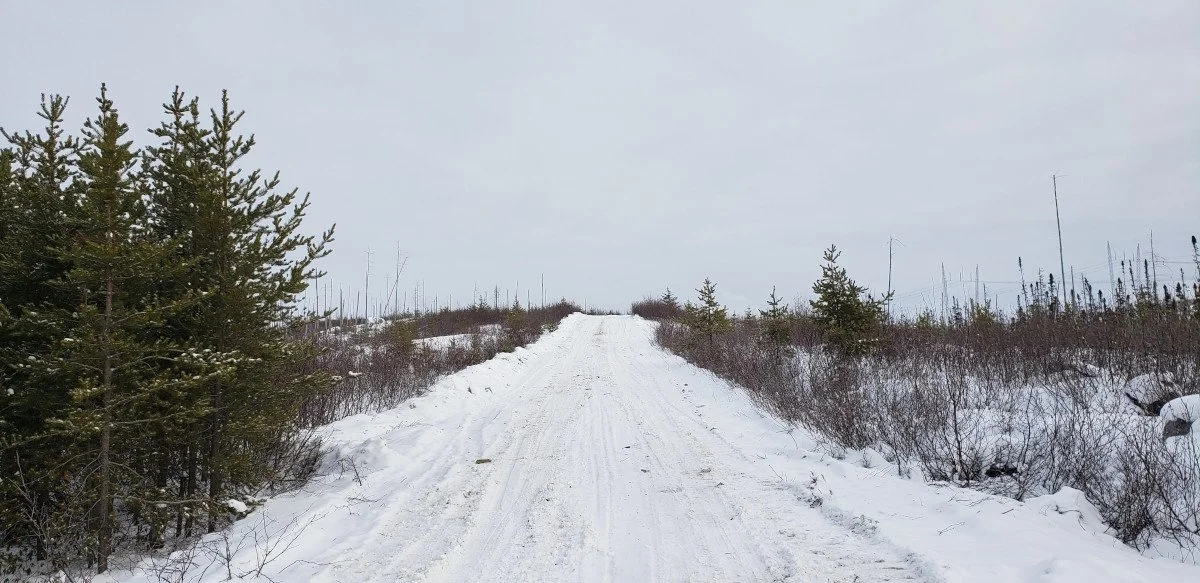
NISK — not just a mine.
A district to be discovered.
Start with the story. Stay for the detail. The full drill data is one tab deeper — jump to it if that's what you came for.
Three discoveries. One address.
NISK began as a nickel deposit. Then the final hole of the winter 2023 program, 5.5 km to the northeast, hit something richer — and the project became a polymetallic district hunt. Deposits of this family (orthomagmatic — think Norilsk, Voisey's Bay) rarely come alone. Power Metallic holds 80% of the core Nisk claims, acquired from Critical Elements Lithium in April 2024, and controls a ~330 km² district with roughly 50 km of prospective basin margins.
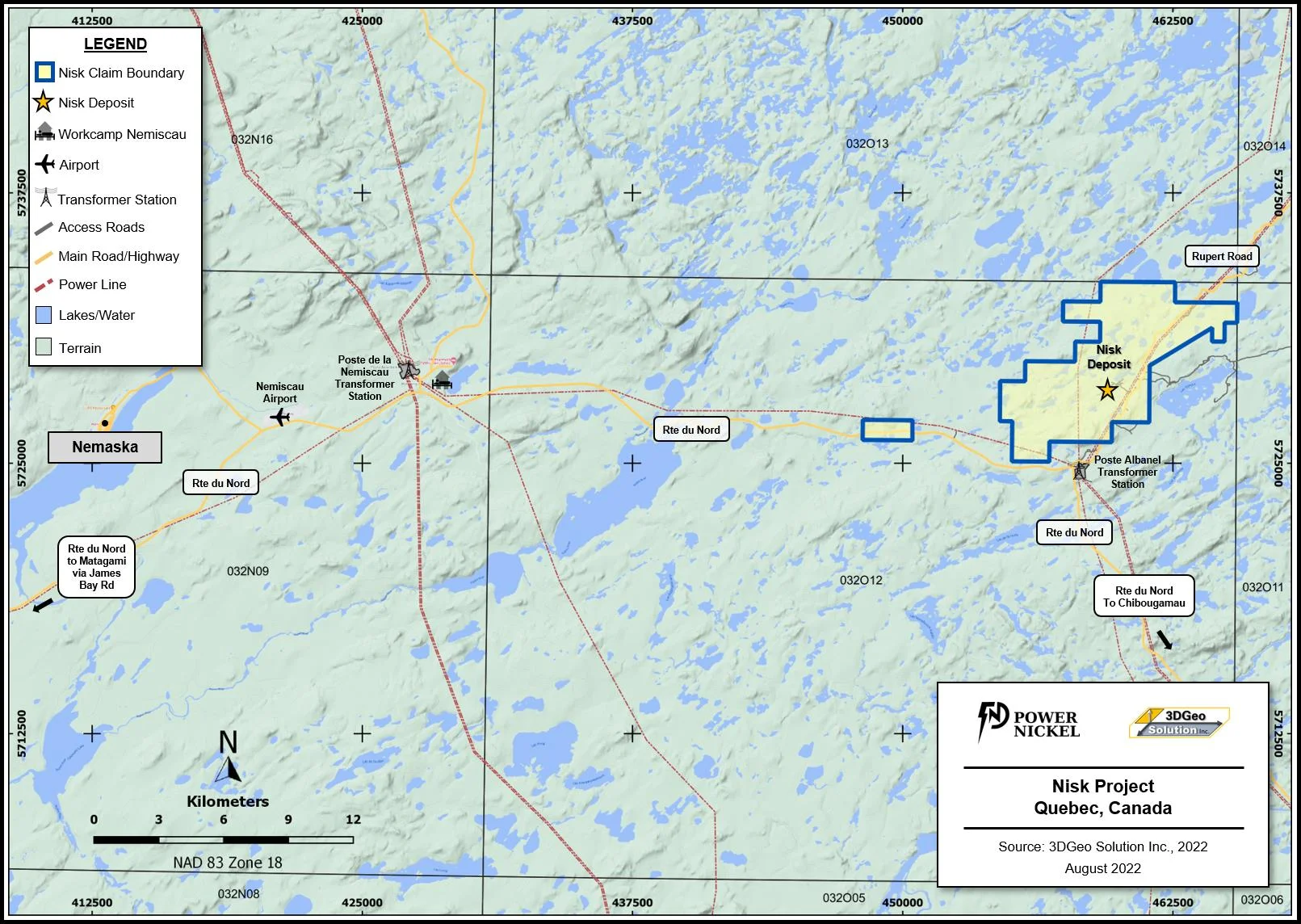
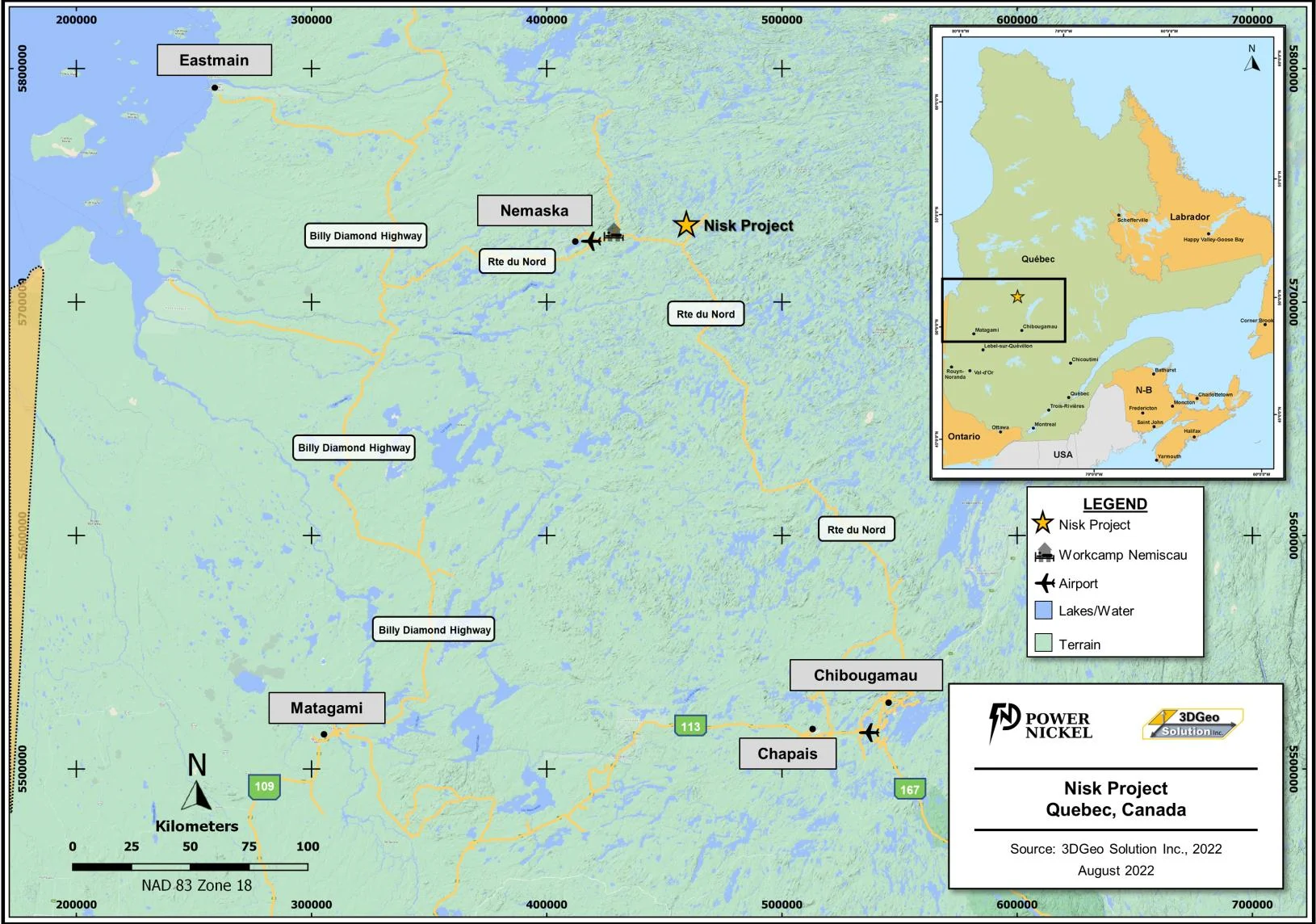
Albanel substation (735 kV Hydro-Québec grid): ~4 km from Nisk Main, ~9.1 km from Lion. Route du Nord: all-season access. Nemiscau airport: ~30 km west. Grid allocations of 5 MW or more require Quebec ministerial authorization — proximity is the setting, connection is the work ahead.
What the drills have proven.
| HOLE | INTERVAL | CU % | PD G/T | PT G/T | AU G/T | AG G/T | NI % | CuEq | AUEQ |
|---|---|---|---|---|---|---|---|---|---|
| PML-26-101 | 39.0 m | 1.89 | 3.51 | 3.34 | 1.0 | 16.3 | 0.13 | 5.6% | 6.46 |
| PN-24-047 | 14.4 m | 8.17 | 6.30 | 8.40 | 0.6 | 69.1 | 0.60 | 15.8% | 18.38 |
| PN-24-070 | 32.0 m | 3.62 | 8.10 | 2.50 | 0.5 | 20.9 | 0.20 | 8.7% | 10.09 |
| PML-26-049 | 16.55 m | 10.08 | 5.54 | 1.13 | 1.6 | 47.4 | 0.42 | 15.1% | 17.54 |
| PML-26-095 | 24.5 m | 4.43 | 4.30 | 4.60 | 2.6 | 21.1 | 0.25 | 10.4% | 12.02 |
| Average (length-weighted) | 25.3 m | 4.60 | 5.40 | 3.70 | 1.2 | 28.5 | 0.30 | 9.7% | 11.26 |
Two locked-cycle tests. One copper concentrate — carrying the palladium, platinum, gold and silver.
SGS Canada tested a medium-grade composite (LCT-01) and a low-grade, disseminated composite (LCT-03). Both produced a copper concentrate above 25%.
| PRELIMINARY TEST | CU IN FEED | CU IN CONCENTRATE | CU RECOVERY |
|---|---|---|---|
| LCT-01 — medium-grade composite | 3.42% | 25.8% | 98.9% |
| LCT-03 — low-grade disseminated composite | 0.62% | 25.4% | 98.3% |
Low-grade feed. Still a high-grade concentrate. The LCT-03 result supports including Lion's lower-grade disseminated material in the resource.
LCT-01 LOCKED-CYCLE RECOVERIES
Preliminary laboratory results, not commercial plant performance or smelter terms. The Lion MRE applies 98.5% copper recovery; other metal and Nisk Main assumptions differ — see Mineral resources in the data room below.
The single concentrate also carries the nickel. Hydrometallurgical testing is evaluating a direct-to-metal route for Lion concentrates.
Lion. Locked-cycle flotation on Lion composites recovered 98–99% of the copper into a 25%+ copper concentrate carrying the precious metals: a medium-grade composite made 25.8% Cu at 98.9% Cu recovery (93.9% Pd, 96.8% Pt); a 0.62% Cu low-grade composite still made 25.4% Cu at 98.3% Cu recovery. Mineralogy is chalcopyrite-dominant with no deleterious minerals of significance. SGS concluded "no significant metallurgical risks were identified."
Nisk Main. A 2023 locked-cycle test (XPS) produced a nickel concentrate grading 12.9% Ni and 4.9% Cu, recovering 70% of the nickel. Copper recovery is lower (44%) because about half of Nisk's copper sits in valleriite, a mineral that does not float well — which is why the resource uses 44% Cu recovery for Nisk and 98.5% for Lion. Earlier SGS Lakefield work found no smelter-penalty elements.
Preliminary laboratory results, not plant performance. NI 43-101 Technical Report §13, pp.129–151.A low-grade copper mine has to move a mountain to make a tonne of metal, and it pays for that mountain up front. Lion is the opposite shape: high-grade mineralization that begins at surface, modelled continuously to more than 600 m, with a 735 kV substation and an all-season road next door, in a province that lists copper, nickel, cobalt, platinum and palladium as critical minerals. That is the recipe for a first mine with a modest footprint and modest capital — and the PEA, targeted for the first half of 2027, is where that argument gets its numbers.
"Combine this with High-grade mineralization from surface, our location next to existing road and power infrastructure, lets us design a project with a modest initial footprint and capital requirement."
The PEA will evaluate an initial open pit followed by underground mining at Lion, with processing options including potential Nisk Main feed. No economic study has been completed; capital cost, operating economics and mine design are the study's job, not this page's.
Since the April 19 resource cut-off the priority has been the shoot below 600 m: deep step-outs and wedge holes from existing collars, followed by borehole EM from the deepest holes.
19,000 m assigned across six targets, 10,000 m reserved to follow success, and the balance into the new year:
A gold-bearing structure cut in PMX-25-016 — 34.6 g/t Au over 1.5 m with visible gold — was intersected again more than 1,000 m vertically below (2.56 g/t Au over 1.5 m at 1,428.5 m).
Nisk West: a 1.8 km × 3.3 km magnetic high ~5 km west of Nisk, with a Cu-Ni-in-till anomaly; ultramafic intrusive bodies confirmed by drilling.
Nisk East: a 1 km × 1.2 km area between Lion and Nisk, interpreted to be the folded extension of the Lion Zone.
49 overburden holes / 431.76 m. NI 43-101 Technical Report §10.5.3, p.91.The 2026 mineral resource statement, plus every assay interval, collar and survey from the NISK program, searchable and downloadable in full.
Open the data roomMineral resources — Lion and Nisk Main, 2026
Independent estimate by SGS Canada, effective June 19, 2026, using drilling completed to April 19, 2026. Figures are project totals; Power Metallic holds an 80% interest. Reproduced from the Company's news release of September 8, 2026.
Lion Deposit — cut-off 0.35% CuEq (open pit) / 0.90% CuEq (underground)
| MINING METHOD | CLASS | TONNES | NI % | CU % | CO % | PT G/T | PD G/T | AU G/T | AG G/T | NIEQ % | CUEQ % |
|---|---|---|---|---|---|---|---|---|---|---|---|
| Open pit | Indicated | 2,782,000 | 0.08 | 1.47 | 0.004 | 0.84 | 2.35 | 0.42 | 11.65 | 2.07 | 3.45 |
| Inferred | 100,000 | 0.07 | 1.09 | 0.004 | 0.43 | 1.31 | 0.31 | 9.63 | 1.41 | 2.36 | |
| Underground | Indicated | 1,363,000 | 0.13 | 2.10 | 0.007 | 0.87 | 3.15 | 0.62 | 13.35 | 2.83 | 4.71 |
| Inferred | 501,000 | 0.14 | 1.99 | 0.007 | 0.62 | 3.17 | 0.43 | 13.04 | 2.60 | 4.34 |
Lion totals: 4.145 Mt Indicated at 3.86% CuEq (1.68% Cu, 2.61 g/t Pd, 0.85 g/t Pt, 0.49 g/t Au, 12.21 g/t Ag, 0.10% Ni); 0.601 Mt Inferred at 4.01% CuEq (1.84% Cu, 2.86 g/t Pd, 0.59 g/t Pt, 0.41 g/t Au, 12.47 g/t Ag, 0.13% Ni). Over 85% of the Lion resource is classified as Indicated.
Contained metal, Indicated (in situ): open pit 90.04 Mlb Cu, 210,000 oz Pd; underground 63.03 Mlb Cu, 138,000 oz Pd — before mining dilution, losses, recovery and payability. Not production, revenue or a valuation. Inferred material excluded.
Nisk Deposit — cut-off 0.30% NiEq (open pit) / 0.80% NiEq (underground)
| MINING METHOD | CLASS | TONNES | NI % | CU % | CO % | PT G/T | PD G/T | AU G/T | AG G/T | NIEQ %* | CUEQ %* |
|---|---|---|---|---|---|---|---|---|---|---|---|
| Open pit | Indicated | 607,000 | 0.60 | 0.35 | 0.039 | 0.08 | 0.49 | 0.03 | 2.19 | 1.01 | 1.68 |
| Inferred | 210,000 | 0.54 | 0.22 | 0.035 | 0.07 | 0.48 | 0.03 | 2.04 | 0.86 | 1.44 | |
| Underground | Indicated | 2,096,000 | 0.96 | 0.53 | 0.061 | 0.21 | 0.91 | 0.04 | 2.00 | 1.65 | 2.75 |
| Inferred | 1,806,000 | 0.98 | 0.57 | 0.063 | 0.26 | 1.05 | 0.03 | 1.57 | 1.73 | 2.89 |
Nisk Main totals: 2.703 Mt Indicated; 2.016 Mt Inferred. *Nisk NiEq and CuEq are exclusive of gold and silver and use different recoveries from Lion; no blended deposit grade is shown.
Lion Indicated contains ~153 Mlb copper and ~348 koz palladium; Nisk Main Indicated ~52 Mlb nickel (sums of open-pit and underground rows, Table 14-10).
Sensitivity: At a 2.0% CuEq cut-off the Lion underground Indicated resource would be 751 kt at 7.50% CuEq (3.44% Cu, 4.93 g/t Pd) — a sensitivity case, not the resource statement.
Values in these tables reported above and below the base-case cut-off grades … should not be misconstrued with a Mineral Resource Statement (NI 43-101 Technical Report, p.179).Basis of the estimate
Prepared under NI 43-101 and CIM Definition Standards (2014). Marc-Antoine Laporte, M.Sc., P.Geo., of SGS Canada Inc. is the independent Qualified Person responsible for the Nisk and Lion Mineral Resource Estimates. Grades were estimated by inverse distance squared interpolation from capped composites within 3D resource domains built in Leapfrog Geo; the mineral resource is presented undiluted and in situ, constrained by a 3D grade control resource model, and is considered to have reasonable prospects for eventual economic extraction.
Cut-offs: Lion 0.35% CuEq open pit / 0.90% CuEq underground; Nisk 0.30% NiEq / 0.80% NiEq. Metal prices (US$): Ni $8.00/lb, Cu $4.80/lb, Co $15.00/lb, Pt $1,400/oz, Pd $1,200/oz, Au $3,600/oz, Ag $38/oz. Recoveries — Lion: Ni 63%, Cu 98.5%, Co 70%, Pt 90%, Pd 92%, Au 84%, Ag 82%; Nisk: Ni 70%, Cu 44%, Co 79%, Pt 27%, Pd 67% (Au and Ag not considered). Open-pit and underground labels describe the constraints used to report resources, not an adopted mining sequence. All figures are rounded to reflect the relative accuracy of the estimate and numbers may not add due to rounding.
Mineral resources which are not mineral reserves do not have demonstrated economic viability. An Inferred Mineral Resource has a lower level of confidence than that applying to an Indicated Mineral Resource and must not be converted to a Mineral Reserve. The estimate may be materially affected by environmental, permitting, legal, title, taxation, socio-political, marketing or other relevant issues.
Mineral resources estimated by Marc-Antoine Laporte, M.Sc., P.Geo. (OGQ #1347), SGS Canada Inc., an independent Qualified Person under NI 43-101; site visit June 15–17, 2026. Technical Report on the Nisk and Lion Projects, effective June 19, 2026, report date October 23, 2026.
Historical — 2023 Nisk Main estimate (superseded)
The November 2023 estimate for Nisk Main (in excess of 5.4 Mt Indicated at 1.05% NiEq and 1.8 Mt Inferred at 1.35% NiEq, at its own cut-offs and price assumptions) is superseded by the June 19, 2026 estimate above and is retained for reference only. See the 2023 news release and the 2023 technical report under Reports.
Published drill tables
Collar, survey and multi-element assay tables for Nisk Main, Lion, Tiger and the ANT targets — the same published datasets as the full explorer. Download the files here, or open the explorer to read every row in the browser.
Independently checked. SGS compared roughly 20% of the digital assay records against the laboratory certificates — certificates exist for every hole — and found no adjustments were needed.
NI 43-101 Technical Report §12, p.127.
Assays by ISO/IEC 17025-accredited laboratories (Actlabs, ALS). Blanks, certified standards and duplicate checks on every batch; 99% of blanks passed, duplicates R² > 0.99 for Ni, Cu, Au, Pt and Pd (TR §11).
Assays list interval grades for Ni, Cu, Pt, Pd, Co, Au and Ag. Collars list hole location, elevation, length, year and type. Surveys list downhole distance, azimuth and dip.
Excel workbook as published — data updated on June 9, 2025. Core tables and downloads remain available without JavaScript.
Who has drilled Nisk
| Year | Operator | Holes | Metres |
|---|---|---|---|
| 1964–1969 | Inco | 22 | 3,876.31 |
| 1988 | Muscocho Explorations | 16 | 1,842.60 |
| 2007 | Golden Goose | 46 | 8,950.30 |
| 2008 | Golden Goose | 18 | 4,244.20 |
| 2010 | Nemaska Exploration | 2 | 1,097.40 |
| 2011 | Nemaska Exploration | 11 | 2,824.00 |
| 2021–2025 | Power-Nickel | 114 | 45,699.24 |
| 2025–2026 | Power Metallic Mines | 157 | 60,428.85 |
| 2026 | Power Metallic Mines (overburden) | 49 | 431.76 |
Figure 1 of 17
Use Previous and Next, or the Left Arrow, Right Arrow, Home and End keys, to change the displayed figure.


Where is this all headed?
“In February we made the call to concentrate the winter program on delineating the near-surface portion of Lion, so that this estimate could support the engineering studies ahead. The Indicated resource reported today does that. It also puts a substantial floor under the project while leaving the ceiling open: the estimate uses drilling completed to April 19, 2026, and, as the long section in this release shows, the resource model ends where that drilling ended.”
The model ends. The exploration doesn't.
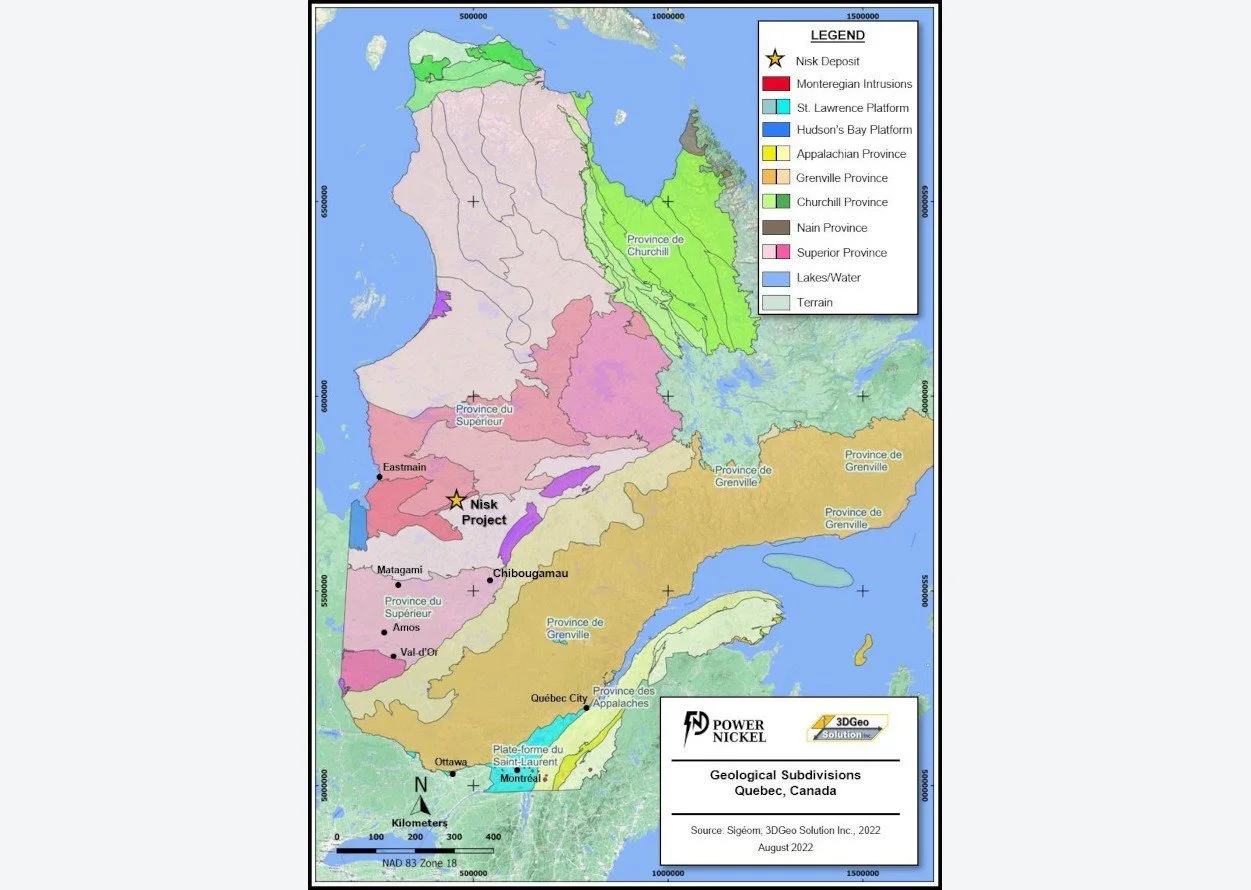
Lion is open at depth, and the CEO has put the next question plainly: how deep does Lion go, and where did the nickel go? The model described in the 2026 technical report is a magmatic sulphide system in which nickel-rich sulphide crystallises first and the copper-and-precious-metal liquid travels furthest — Lion being that far-travelled end-member (NI 43-101 TR §7.4.2, §8.1), with the nickel-rich source still to be found. That is an exploration thesis, not a second deposit; it is also exactly what five rigs, deep step-outs and borehole EM are now testing. Drilling since the resource cut-off will be brought into future resource updates and the PEA to the extent practicable.
District-scale, measured.
| Survey | Year | Contractor | Coverage |
|---|---|---|---|
| Heliborne mag + TDEM | 2023 | Prospectair | 508 line-km |
| LiDAR + orthophoto | 2023 | LiDAR Services International | 10 cm pixels |
| Ambient-noise tomography | 2024 | Fleet | 6 surveys |
| Ground gravity | 2024 | TMC Geophysics | 4,592 stations / 98 lines |
| Ground EM | 2024 | TMC/Crone | 32 lines / 3 loops over Lion |
| Heliborne LiDAR | 2025 | LiDAR Services International | 277 km² |
| Heliborne VTEM Max + mag | 2025 | Geotech | 2,270 line-km / 3 blocks |
| 3D magnetic inversion | 2025 | Hardrock Geophysics | 10 km RTP dataset |
| Soil geochemistry database | — | Li-FT | 11,579 samples |
| 2025 field mapping | 2025 | Power Metallic | 1,133 outcrop samples, 70 ultramafic + 49 high-Mg gabbro outcrops |
| Borehole EM | 2023–2026 | TMC | 67 surveys |
Exploration targets, not resources. The strongest EM conductor on the property — 2 km southwest of Nisk Main — has never been drilled. Two more anomalies of Lion-like intensity sit in the same rock unit as the Lion discovery hole.
A PEA targeted for the first half of 2027, with a feasibility study to follow. See the calendar and the capital behind it.
The independent plan: C$35 M, PEA first.
SGS's independent Qualified Person recommends a three-phase program. Phase I (C$5.7 M) — the Preliminary Economic Assessment, starting November 2026 for completion in Q2 2027, with baseline environmental and community work; it is the Company's primary focus and does not depend on the later phases. Phase II (C$18.9 M) — 30,000 m of extension drilling at Lion and Nisk Main with borehole EM and an updated resource. Phase III (C$10.4 M) — regional mapping, geophysics and 15,000 m of exploration drilling along the Nisk–Lion trend. Phases II and III are at the Company's discretion and subject to funding.
Source: NI 43-101 Technical Report, SGS, §26, pp.203–205.
Recommended program budget (Table 26-4)
| Phase | Scope | Cost (C$) |
|---|---|---|
| I | PEA and project advancement | 5,190,000 |
| II | Lion and Nisk Main extension drilling (30,000 m) | 17,204,000 |
| III | Regional exploration (15,000 m) | 9,426,000 |
| Sub-total | 31,820,000 | |
| Contingency (10%) | 3,182,000 | |
| Total | 35,002,000 | |